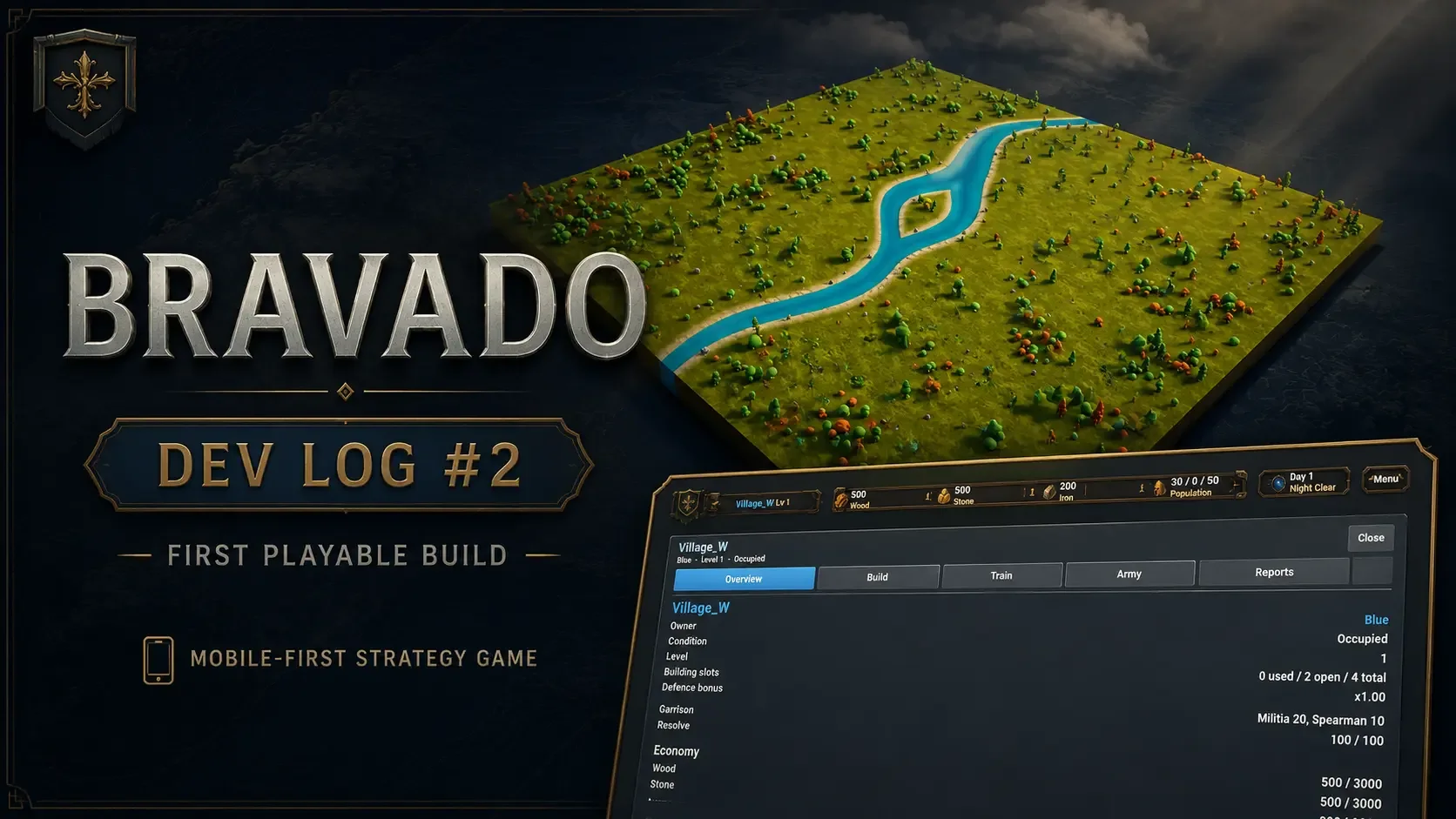
After working on my first game for a while, I decided to move on to another project that I consider easier and more realistic to develop.
The new game is called Bravado. It is a mobile-first strategy game focused on managing villages, resources, armies and expansion across a large map. I will keep the deeper mechanics vague for now because I would rather show them once the game is further developed.
One of my first problems was the map.
I do not know 3D modelling, so instead of forcing myself into a workflow I did not understand, I used drawing, textures and simple effects to create the world. That included making the river look animated, despite it mostly being built from static artwork.
The result currently looks like this:
Before writing much code, I spent around two weeks designing the game systems. I wrote several PDFs explaining how each part should work, including the rules, data structures, interactions and edge cases.
They were basically enormous prompts, divided into smaller systems.
Claude then took those two weeks of planning and turned a large part of it into working code in around two hours.
I am both happy and slightly sad about that.
I am happy because it was incredibly fast, the systems worked as intended, and the detailed PDFs clearly paid off. Claude was not inventing the game for me. It was implementing rules and structures that I had already designed.
At the same time, it was genuinely humbling.
Writing the same amount of code manually would probably have taken me around thirty times longer. Seeing weeks of planning become functional software in a couple of hours makes you question what the development process will look like in the future.
Still, the code only worked because the design was already clear. The planning, testing and decisions still had to come from somewhere.
This is what the first proper iteration looks like:
It is still very early, but the foundation is now there.
I will share how it develops, what works, and what inevitably breaks in Dev Log #3.